Fence Gate Sizes — Walk, Double & Drive Gate Guide
Gates are the most failure-prone part of any fence. Get the width wrong and you are rebuilding. Get the posts wrong and the gate sags within a year. This guide covers standard sizes, post requirements, hardware, and the details that keep gates working for decades.
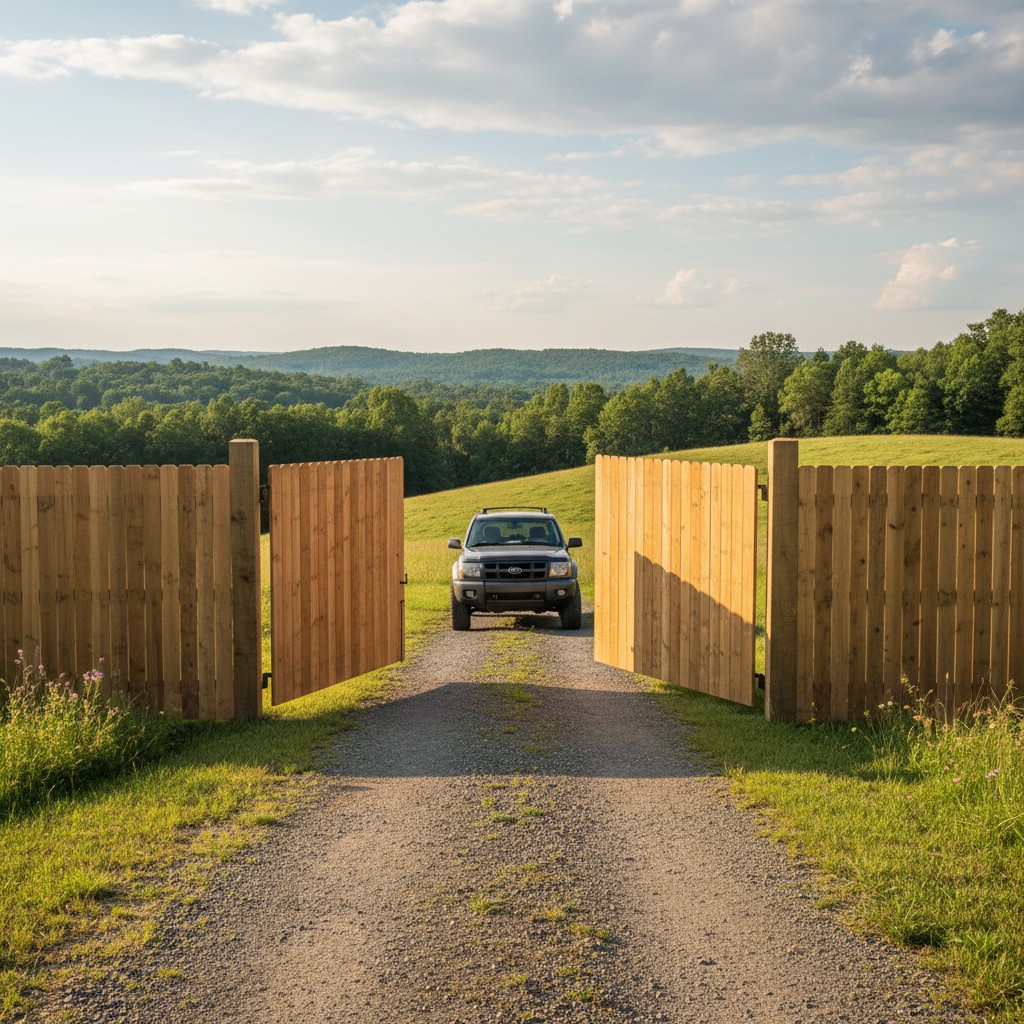
Standard Gate Sizes
Fence gates fall into three categories based on what needs to pass through them. Choosing the right size upfront prevents the costly mistake of tearing out and re-setting gate posts later.
| Gate Type | Width | Common Uses |
|---|---|---|
| Walk gate (single) | 3 – 3.5 ft | Pedestrian access, side yards |
| Double gate | 6 – 8 ft | Riding mowers, ATVs, trailers |
| Drive gate (swing) | 10 – 14 ft | Cars, trucks, SUVs |
| Drive gate (sliding) | 12 – 16 ft | Driveways with limited swing clearance |
Walk gates narrower than 36 inches cause constant frustration. You will not fit a wheelbarrow, stroller, or large trash can through a 30-inch gate. If you are debating between 3 and 3.5 feet, go wider — the material cost difference is negligible, and you will never regret the extra space.
How to Choose Gate Width
The most reliable way to choose gate width is to measure what actually needs to go through it:
- Walk gate: A standard wheelbarrow is 25–27 inches wide. Add clearance for knuckles and you need at least 36 inches. If you ever plan to bring a riding mower through, go to 4 feet.
- Double gate: Measure your largest piece of equipment. A standard riding mower is 42–54 inches wide. A single-axle utility trailer is 48–60 inches. A 6-foot double gate handles most residential equipment; go 8 feet if you have a wide trailer.
- Drive gate: Measure your widest vehicle including side mirrors. A full-size truck with mirrors is typically 96–102 inches (8–8.5 ft). Add 2 feet minimum for comfortable clearance, which puts you at 10–10.5 feet as the absolute minimum. Most installers recommend 12 feet for residential drive gates because it allows some margin for error when pulling in at an angle.
Tip: Think about future needs. Even if you currently drive a sedan, the next owner might have a truck. A 12-foot drive gate costs only marginally more than 10-foot and provides much better resale flexibility.
Gate Post Requirements
Gate posts endure forces that line posts never see. Every time a gate swings, the posts absorb lateral stress, torque, and impact. Under-sized gate posts are the number one cause of sagging gates.
| Gate Type | Minimum Post Size | Hole Depth | Concrete (per post) |
|---|---|---|---|
| Walk gate | 6x6 | 36 in | 3 bags (80 lb) |
| Double gate | 6x6 | 36 – 42 in | 3 – 4 bags |
| Drive gate (swing) | 8x8 or steel | 42 – 48 in | 4 – 5 bags |
For fences 5 ft and taller, always use 6x6 posts for gates — even small walk gates. A 4x4 simply does not have enough cross-section to resist the racking forces at that height. For short 3-4 ft fences with lightweight gates, 4x4 gate posts can work if set in concrete. Concrete is not optional for gate posts — even in firm clay soil, the repeated stress of opening and closing will work a non-concreted post loose within a season or two. For detailed post-setting instructions, see our fence post installation guide.
Hardware Requirements
Gate hardware is often an afterthought, but it directly determines how well and how long your gate functions. Here is what you need for each gate type:
- Hinges: Use 2 hinges for gates under 4 feet tall, 3 hinges for gates 4–6 feet. Heavy-duty strap hinges or self-closing spring hinges are standard. For gates over 100 lbs (composite or solid wood), use ball-bearing hinges rated for the weight. Budget $15–$40 per hinge depending on quality.
- Latches: A basic gravity latch works for walk gates. For security, use a lockable thumb latch or key-lockable latch. Pool-area gates require self-closing hinges and self-latching hardware by code — the latch must be at least 54 inches from the ground to prevent child access.
- Drop rods: Double gates need a drop rod (also called a cane bolt) on the stationary leaf. This pins one gate panel to the ground so the other can latch against it. Without a drop rod, both panels swing freely and nothing holds them in position. Cost: $15–$30.
- Gate wheels: For wide or heavy gates, a gate wheel on the latch side prevents the gate from dragging on the ground. Particularly useful for 8-foot double gates and any drive gate. Cost: $20–$50.
Preventing Gate Sag
Gate sag is inevitable if you do not actively prevent it. Gravity is persistent, and even well-built gates will develop some droop over the years. The goal is to slow this process to near-zero:
- Anti-sag gate kits: These use a steel cable and turnbuckle running from the top of the hinge side to the bottom of the latch side (forming a triangle). As the gate begins to sag, you tighten the turnbuckle to pull it back square. Cost: $15–$25. Every gate should have one.
- Diagonal bracing: A 2x4 or metal brace from the bottom hinge corner to the top latch corner creates a structural triangle. The brace should run "uphill" from the bottom of the hinge post to the top of the latch side. If it runs the other direction, it pushes the gate down instead of supporting it.
- Proper hinge placement: Mount the top hinge as high as practical and the bottom hinge as low as practical. This maximizes the leverage arm and reduces stress on each individual hinge. For a 6-foot gate, place hinges 8–12 inches from the top and bottom edges.
- Gate post depth: Even with perfect bracing, a gate will sag if the hinge post leans. Set gate posts at least 36 inches deep in concrete, regardless of your local frost line. For our guide on concrete quantities per post, see the dedicated article.
Gate Placement Tips
Where you place your gate matters as much as how you build it:
- Avoid low points. Water pools at the lowest part of your yard. Placing a gate there means dealing with mud, ice, and standing water that accelerates rot and makes the gate hard to open in winter. If a low point is unavoidable, build a gravel pad under the gate swing area.
- Consider swing direction. Gates should swing inward (toward the yard) so they cannot be pushed open from outside. Pool gates are required by code to swing away from the pool. For drive gates on slopes, swing direction determines ground clearance — always check that the gate clears the ground throughout its full arc.
- Plan for the path of travel. Walk gates should align with walkways or natural foot paths. Do not force people to walk along the fence to reach a gate placed at an arbitrary point.
- Leave room for the gate to open. A 3.5-foot walk gate needs at least 3.5 feet of clear space on the swing side. Check for shrubs, downspouts, AC units, and other obstacles before setting posts.
For a complete walkthrough of building the fence that surrounds your gate, see our how to build a privacy fence guide.
Related Topics
- Fence Material & Cost Calculator — Estimate posts, rails, boards, and cost for your fence
- How to Install Fence Posts — Step-by-step guide to setting posts plumb and solid
- How to Build a Privacy Fence — Complete DIY tutorial from layout to finishing
- How Much Concrete for Fence Posts? — Bags per post calculated by hole size