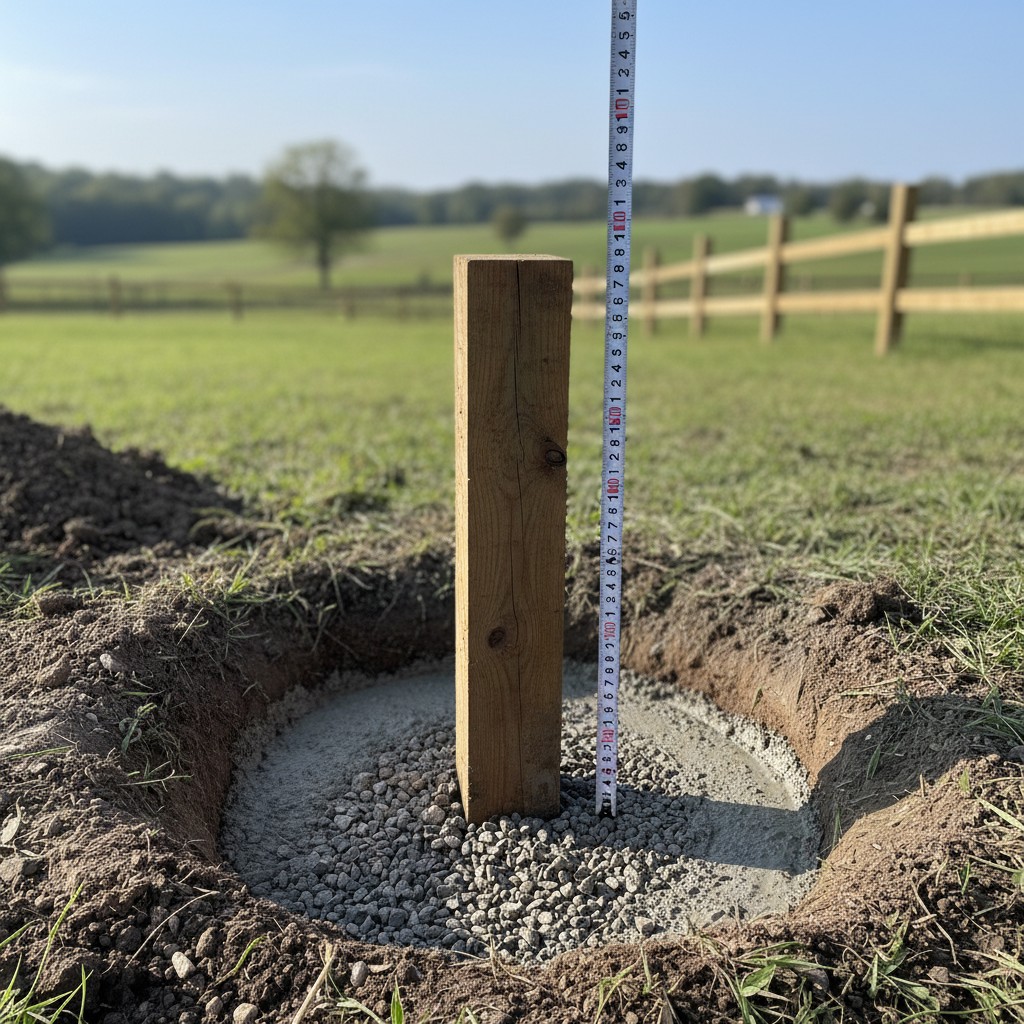
How Deep Should Fence Posts Be? Depth Guide by Height
Post depth is the single most important factor in a fence's long-term stability. Set posts too shallow and your fence will lean, wobble, or blow over in the first strong wind. Go deep enough and your fence will stand straight for 15-20 years with minimal maintenance. This guide gives you exact depth recommendations by fence height, soil type, and climate zone.
The 1/3 Rule
The traditional guideline for fence post depth is: one-third of the total post length should be underground. This is a conservative rule that ensures maximum wind resistance and stability.
In practice, most builders work with standard lumber sizes (6ft, 8ft, 10ft, 12ft posts) and target the depths in the table below. For example, the most common setup — a 6-foot privacy fence — uses standard 8-foot posts with 24 inches buried. That's plenty for most climates and soil types. In cold or high-wind areas, step up to a 10-foot post for deeper burial.
Absolute minimum: Regardless of what the 1/3 rule calculates, never set a fence post less than 24 inches deep. For a 3-foot garden fence, the 1/3 rule gives you only 18 inches of burial — bump it up to 24 inches. Use our fence calculator to see the recommended post length for your fence height.
Depth by Fence Height
Here is a quick-reference table showing the recommended post depth and total post length for standard fence heights. These assume normal soil conditions and a climate with a moderate frost line (24 inches or less).
| Fence Height | Post to Buy | Buried Depth | Hole Diameter | Post Size |
|---|---|---|---|---|
| 3 feet | 6 ft | 24" (minimum) | 10 – 12" | 4x4 |
| 4 feet | 6 ft | 24" | 10 – 12" | 4x4 |
| 5 feet | 8 ft (trim to 7.5ft or bury 36" for extra stability) | 30 – 36" | 12" | 4x4 |
| 6 feet | 8 ft | 24" (30-36" in cold climates) | 12" | 4x4 or 6x6 |
| 7 feet | 10 ft | 36" | 12 – 14" | 6x6 |
| 8 feet | 12 ft | 42 – 48" | 14 – 16" | 6x6 |
The 6-foot row is highlighted because it's the most common residential privacy fence height.
Before you dig: Call 811 at least 48 hours before digging any post holes. A locator will mark underground gas, electric, water, and cable lines in your yard — for free. This is required by federal law.
Gate posts and corner posts should always be at the deeper end of the range (or 6 inches deeper) and use the larger post size. These posts bear more lateral force than line posts, especially gate posts that absorb the repeated stress of the gate swinging open and closed.
Frost Line Considerations
In cold climates, the frost line — the depth to which the ground freezes in winter — adds another constraint to your post depth. When wet soil freezes, it expands and pushes upward. If your post's concrete footing sits above the frost line, this "frost heave" can gradually push the post up and out of the ground, tilting your fence.
The rule: Post footings should extend to at least the frost line depth, or to the 1/3 rule depth — whichever is deeper.
| Region | Approximate Frost Line | Example States |
|---|---|---|
| Deep South / Gulf Coast | 0 – 12 inches | Florida, Louisiana, southern Texas, coastal Carolinas |
| Mid-South / Mid-Atlantic | 12 – 24 inches | Tennessee, Virginia, Kentucky, North Carolina |
| Midwest / Northeast | 30 – 48 inches | Ohio, Pennsylvania, Indiana, Illinois, New York |
| Upper Midwest / Northern Plains | 48 – 60 inches | Minnesota, Wisconsin, Montana, North Dakota |
| Northern Mountain / Alaska | 60 – 72+ inches | Interior Alaska, northern Maine, high-altitude Rockies |
In Minnesota (48-60 inch frost line), for example, a 6-foot fence post must go at least 48 inches deep — which means buying 10-foot posts instead of the standard 8-foot. That's a significant increase in both material cost and digging effort, so plan accordingly. Your local building department can tell you the exact frost line depth for your jurisdiction.
Soil Type Adjustments
Not all soil holds a fence post the same way. The composition of your soil directly affects how deep you need to go and what backfill method works best.
- Clay soil: Dense clay provides excellent lateral support and holds posts firmly. Standard depths work well. However, clay retains water, which pools around the post base and accelerates rot. A generous gravel base (6 inches instead of the standard 4) improves drainage significantly in clay.
- Sandy soil: Sand provides poor lateral resistance because it shifts easily under pressure. Increase burial depth by 6-12 inches beyond the standard recommendation, or increase the hole diameter to 14-16 inches to create a wider concrete footing. Both approaches increase the soil resistance against the post.
- Loamy soil: This is the ideal soil for fence posts — good drainage, decent lateral support, and easy to dig. Standard depths and hole diameters work perfectly in loam.
- Rocky soil: If you hit rock at shallow depth, you may not be able to reach the ideal depth. Options include using a concrete collar (a wider concrete pad at the surface), a rock anchor (drilling into the rock and epoxying a threaded rod), or surface-mounted post brackets bolted to a concrete pad.
- High water table: In areas where the water table is close to the surface, posts sit in saturated soil and rot faster regardless of treatment. Consider using steel post inserts or metal post bases that keep the wood above the water line.
Concrete vs Gravel Backfill
The backfill material around your post matters almost as much as the depth. There are two main options, and each has its place.
Concrete
Best for: Gate posts, corner posts, end posts, sandy soil, high-wind areas, tall fences (7-8 feet).
Concrete provides the strongest hold and greatest resistance to lateral movement. Use fast-setting concrete for fence posts — it sets in 20-40 minutes versus 24-48 hours for standard mix. Always place 4 inches of gravel below the concrete for drainage, and crown the concrete above grade so water runs away from the post.
See our concrete quantity guide for exact bag counts per post size.
Tamped Gravel / Crushed Stone
Best for: Line posts in firm soil, clay-heavy ground, areas with poor drainage, temporary or easily replaceable fences.
Fill the hole with 3/4-inch crushed stone (not round pea gravel — the angular edges lock together), tamping every 6 inches with a 2x4 or metal tamping bar. Crushed stone drains freely, which keeps the post base drier and can actually extend post life in wet climates. Posts are also easier to replace later since you just dig out the gravel.
The trade-off: gravel provides less lateral rigidity than concrete, so posts may shift slightly over time in soft soil.
Best of both worlds: Many professional fence installers use a "gravel + concrete" method — 4-6 inches of gravel at the bottom for drainage, then concrete from the gravel up to 2 inches above grade. The gravel prevents water from pooling under the footing, while the concrete provides maximum lateral strength.
Related Topics
- Fence Material & Cost Calculator — Get post lengths and quantities for your project
- How to Install Fence Posts — Step-by-step installation guide
- How Much Concrete for Fence Posts — Exact bag counts by post size and hole depth
- How Many Fence Posts Do I Need? — Post spacing and quantity calculations