How Many Fence Posts Do I Need?
Knowing the exact number of fence posts before you start buying materials saves trips to the lumber yard, prevents over-spending, and keeps your build on schedule. The math is straightforward once you account for post spacing, corners, ends, and gates. This guide gives you the formula, spacing rules for every fence type, a ready-made reference table, and post sizing guidance.
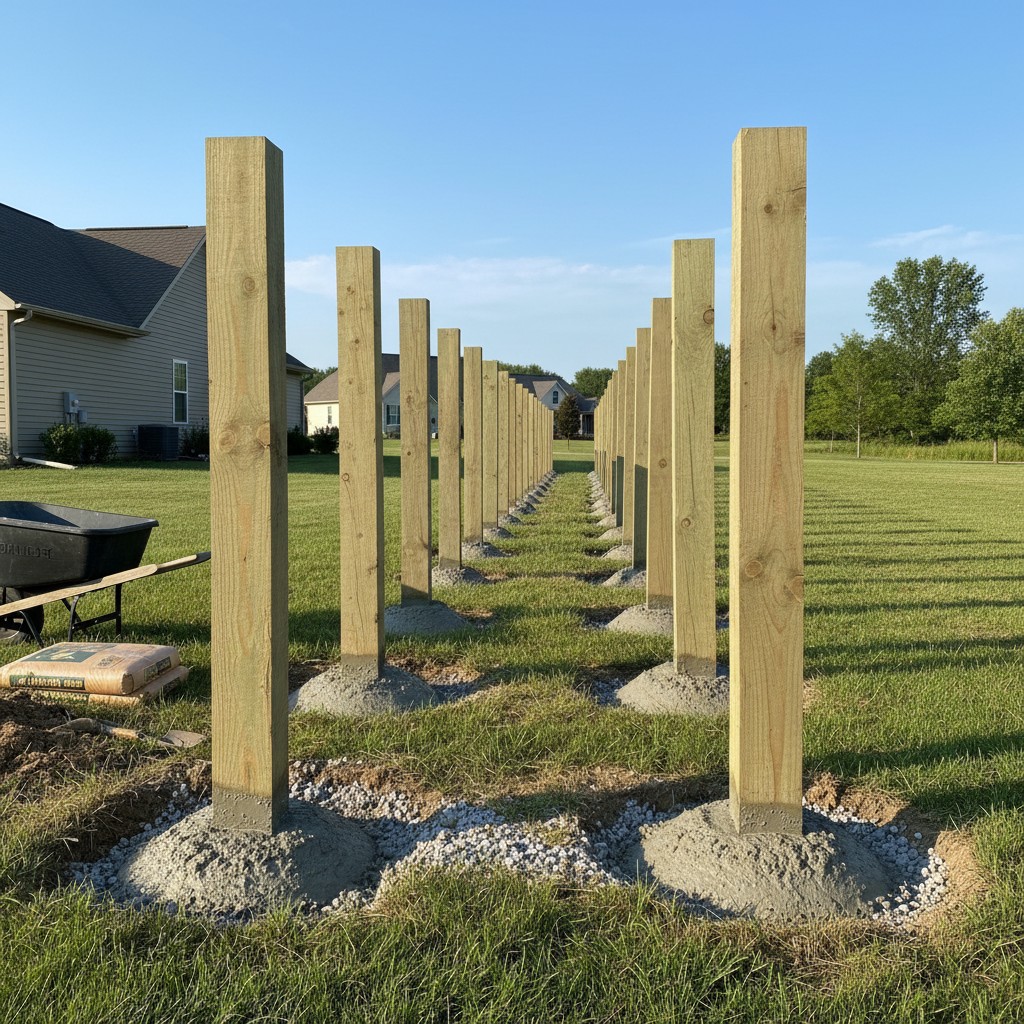
Quick Answer Formula
The basic formula for calculating fence posts is:
Posts = (Fence Length ÷ Post Spacing) + 1 + (Number of Gates × 2)
The "+1" accounts for the fact that a line of fence sections requires one more post than the number of sections. For example, three 8-foot sections need four posts, not three. The "gates × 2" adds the two extra posts required for each gate opening — these are separate from the line posts because the gate breaks the continuous run of fence.
Always round up to the next whole number. If the formula gives you 14.3, buy 15 posts. Partial sections still need a full post at each end. For an instant calculation with your exact dimensions, try our fence material calculator — it handles posts, rails, boards, concrete, and cost in one step.
Worked Example
Suppose you are building a 150-foot wood privacy fence with 8-foot post spacing and two gates:
- 150 ÷ 8 = 18.75, round up to 19 sections
- 19 + 1 = 20 line/end posts
- 2 gates × 2 = 4 gate posts
- Total: 24 posts
Post Spacing by Fence Type
Different fence materials have different standard spacings. Using the wrong spacing leads to sagging rails, panels that do not fit, or a fence that cannot handle wind loads.
| Fence Type | Standard Spacing | Notes |
|---|---|---|
| Wood privacy (board-on-board) | 8 feet | Uses standard 8-ft rail lumber; reduce to 6 ft in high-wind areas |
| Vinyl panel | 6 feet | Panels are pre-fabricated at 6-ft widths; not adjustable |
| Vinyl panel (8-ft) | 8 feet | Some manufacturers offer 8-ft panels; confirm before buying posts |
| Chain link | 10 feet | Tension wire and mesh span 10 ft easily; reduce to 8 ft for 6-ft-tall chain link |
| Split rail | 8 – 10 feet | Depends on rail length (typically 10 or 11 ft rails) |
| Composite panel | 6 – 8 feet | Varies by manufacturer; always check panel width specs |
If you live in a coastal or high-wind area (sustained winds above 50 mph), consider reducing your post spacing by 2 feet from the standard. Closer posts dramatically increase a fence's resistance to wind pressure.
Corner, End & Gate Posts
The simple formula above covers straight runs and gates, but most real fences have corners and direction changes that require additional consideration.
- End posts are the first and last posts in any run of fence. They bear load from only one direction, so they need to be firmly set. The formula already accounts for end posts (that is what the "+1" does).
- Corner posts occur wherever the fence changes direction — typically at property corners. A corner post serves as the end post for one section and the start post for the next, so it does not add an extra post to the count. However, corner posts should be 6x6 (rather than 4x4) because they bear lateral forces from two directions.
- Gate posts must support the weight and swing force of the gate. They should always be 6x6 posts set in concrete, even if your line posts are 4x4. Each gate requires two dedicated gate posts. For wide double gates or drive gates, consider 6x6 posts set 3 feet deep in 12-inch-diameter concrete footings.
For a detailed guide on setting posts at the correct depth, see our fence post depth guide. And for concrete quantities per post, check how much concrete for fence posts.
Reference Table
Below are pre-calculated post counts for common fence lengths at 6-foot and 8-foot post spacing. These counts are for straight runs with no gates — add 2 posts per gate.
| Fence Length | Posts at 6-ft Spacing | Posts at 8-ft Spacing |
|---|---|---|
| 50 ft | 10 | 8 |
| 100 ft | 18 | 14 |
| 150 ft | 26 | 20 |
| 200 ft | 35 | 26 |
| 250 ft | 43 | 33 |
| 300 ft | 51 | 39 |
Post Size Guide
Choosing the right post size affects both structural integrity and cost. The two standard sizes are 4x4 (actual 3.5" x 3.5") and 6x6 (actual 5.5" x 5.5"). Here is when to use each.
| Post Size | Use When | Typical Cost |
|---|---|---|
| 4x4 (8 ft length) | Line posts for fences up to 6 ft tall | $10 – $18 (PT) / $15 – $25 (cedar) |
| 6x6 (8 ft length) | Corner posts, end posts, gate posts, fences over 6 ft | $25 – $45 (PT) / $35 – $60 (cedar) |
For fences 4 feet tall or shorter (like a picket fence), 4x4 posts are fine for all positions including corners and gates. For anything 5 feet or taller — especially solid privacy fences that act as wind sails — upgrade corner and gate posts to 6x6 regardless of what you use for line posts. Ready to figure out your exact material list? Head to the fence post installation guide for step-by-step setting instructions.
Related Topics
- Fence Material & Cost Calculator — Calculate posts, rails, boards, concrete, and cost instantly.
- Fence Post Depth Guide — How deep to set posts for every fence height and soil type.
- How Much Concrete for Fence Posts? — Bag count per post for 4x4 and 6x6 posts.
- How to Install Fence Posts — Step-by-step guide from digging to setting.