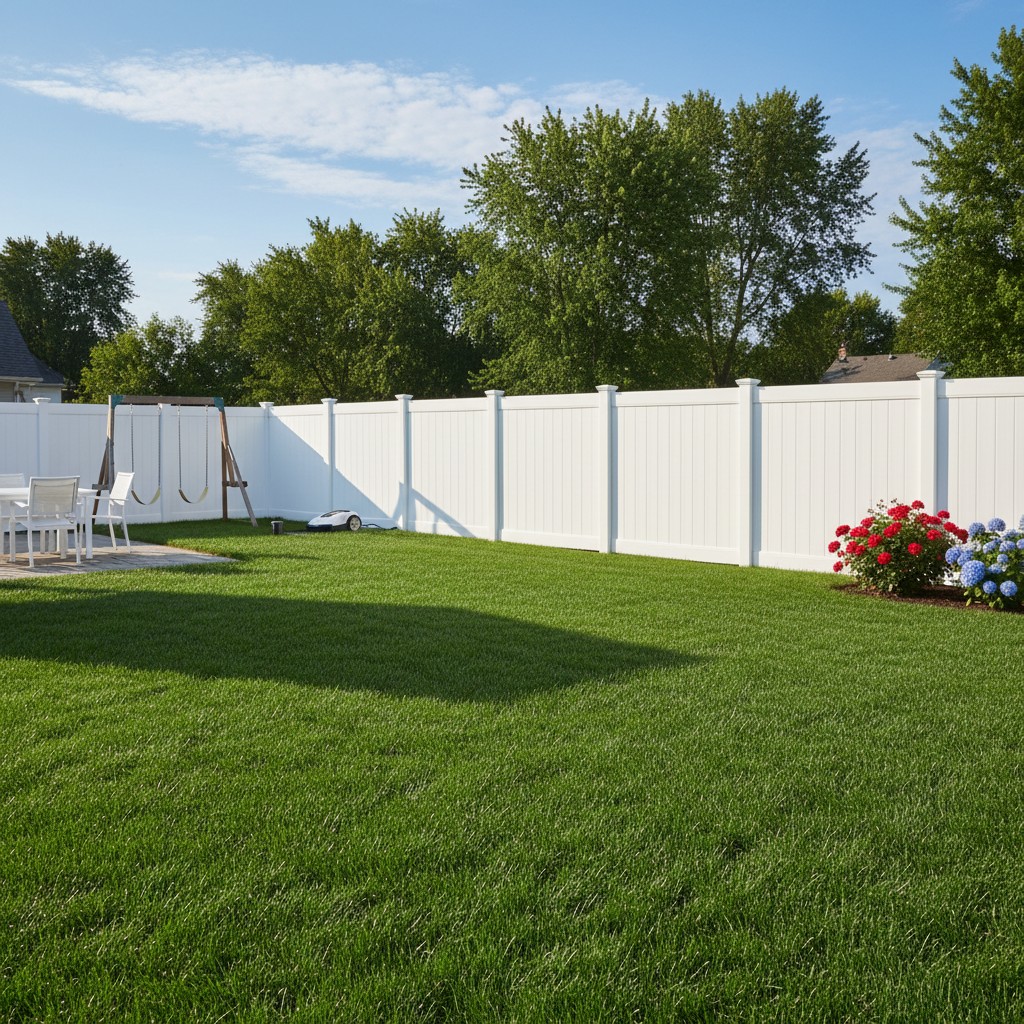
Vinyl Fence Pros and Cons — Is PVC Fencing Worth It?
Vinyl fencing has become the go-to alternative to wood for homeowners who want a fence they can install and essentially forget about. But "maintenance-free" comes with trade-offs: higher upfront cost, limited style options, and some real durability concerns in certain climates. Here is an honest look at what vinyl does well, where it falls short, and whether the premium price is justified for your situation.
Vinyl Fence Pros
Vinyl's advantages are real and significant — there is a reason it has steadily taken market share from wood over the past two decades.
- Virtually zero maintenance: This is the headline benefit and it is genuine. Vinyl does not need staining, sealing, or painting — ever. A once-a-year rinse with a garden hose and mild soap is all it takes to keep it looking new. Compare that to pressure-treated wood that needs restaining every 2-3 years at $0.50-$1.50/LF per DIY application.
- 20 to 30 year lifespan: Quality vinyl fencing lasts 20-30 years, and many manufacturers offer lifetime limited warranties on their products. The vinyl itself does not rot, rust, or decay. Barring physical damage (impact, extreme weather), it outlasts most wood fences.
- No rot or insect damage: PVC is completely impervious to the biological decay that destroys wood fences. Termites, carpenter ants, fungal rot, and moisture damage simply do not apply. In humid climates like the Southeast, this advantage alone can be worth the price premium.
- Consistent appearance over time: A vinyl fence looks the same in year 10 as it did in year 1. No fading, no warping, no boards pulling away from rails. If uniform aesthetics matter to you (or to your HOA), vinyl delivers.
- No splinters or rough surfaces: This matters for families with children and pets. Vinyl surfaces are smooth and will not develop the rough, splintery texture that aging wood produces.
- Available in multiple styles: Privacy, semi-privacy, picket, ranch rail, and shadowbox designs are all available in vinyl. While the options are not as diverse as custom wood, the most popular fence styles are well-represented.
Vinyl Fence Cons
Every material has downsides, and vinyl is no exception. Some of these are minor inconveniences; others are genuine deal-breakers depending on your climate and priorities.
- Higher upfront cost: A vinyl privacy fence costs $25-$40 per linear foot for materials, compared to $12-$25 for wood. For a 150-linear-foot fence, you are looking at $3,750-$6,000 in vinyl versus $1,800-$3,750 in wood. The maintenance savings narrow this gap over time, but the upfront check is substantially larger.
- Limited color selection: White, tan, and gray account for the vast majority of vinyl fence sales. Some manufacturers offer dark colors (brown, black), but darker vinyl absorbs more heat and can warp or distort in hot climates. You cannot stain or paint vinyl the way you can wood.
- Cracking in extreme cold: PVC becomes brittle at very low temperatures. In regions where temperatures regularly drop below -10°F, vinyl panels can crack on impact — a kicked soccer ball, a fallen branch, or even a hard push can snap a panel. This is vinyl's most serious weakness in cold climates.
- Not field-repairable: When a wood fence board gets damaged, you unscrew it and replace it with a new board for $3-$5. When a vinyl panel cracks, you typically need to replace the entire panel section ($50-$150+), and the replacement may not perfectly match the original due to color batch variations. Some damage requires disassembling multiple sections.
- Can look artificial: Despite "wood grain" textures offered by some manufacturers, vinyl still looks like plastic up close. In natural or rustic settings, it can look out of place. This is purely subjective, but it is a common complaint.
- Wind vulnerability: Vinyl privacy fence panels act as solid sails in high winds. While the panels themselves are lightweight, the wind load transfers to the posts. Vinyl fence posts are typically reinforced with internal aluminum or steel channels, but in consistently windy areas, you may need additional bracing or closer post spacing.
- Yellowing in cheap products: Budget vinyl without UV inhibitors can yellow or chalk after 5-8 years of sun exposure. This is not an issue with quality brands that include titanium dioxide UV stabilizers, but it is a real problem with the cheapest products on the market. Buy from reputable manufacturers.
Cost Analysis
The honest question is not "which costs less?" but "which costs less over the life of the fence?" Here is a 20-year total cost comparison for a standard 150-linear-foot, 6-foot privacy fence:
| Cost Category | Vinyl | Wood (Cedar) | Wood (PT Pine) |
|---|---|---|---|
| Materials | $3,750 – $6,000 | $3,200 – $4,500 | $2,000 – $3,000 |
| Professional installation | $2,000 – $3,500 | $2,000 – $3,500 | $2,000 – $3,500 |
| DIY staining/sealing (20 years) | $0 | $500 – $1,200 | $1,050 – $2,250 |
| Repairs (20 years) | $100 – $400 | $200 – $600 | $300 – $800 |
| Replacement (if needed) | $0 (lasts 20+ years) | $0 (cedar lasts 20+) | $2,000 – $3,000 (replace at year 15-18) |
| 20-Year Total | $5,850 – $9,900 | $5,900 – $9,800 | $7,350 – $12,550 |
The striking takeaway: vinyl and cedar are nearly identical in 20-year total cost. The vinyl premium disappears entirely when you factor in the cumulative cost of staining cedar every few years. Pressure-treated pine, despite being the cheapest upfront, often ends up the most expensive over 20 years because it needs the most maintenance and may need full replacement before vinyl or cedar gives out.
Use our fence calculator to compare material costs for your specific project dimensions, or see the full breakdown in our privacy fence cost guide.
Best Uses for Vinyl
Vinyl is not the best choice for every situation, but in the right circumstances it is hard to beat. Here is where vinyl really shines:
- Pool enclosures: Vinyl is arguably the ideal pool fence material. It does not rot from constant moisture exposure, does not produce splinters on bare feet, and cleans easily when splashed with chlorinated water. Many pool fencing codes require specific heights and self-closing gates — vinyl systems are designed to meet these requirements out of the box.
- Front yard curb appeal: A white vinyl picket fence maintains its crisp, clean appearance year after year. For front yards where aesthetics matter and the fence is highly visible, vinyl's consistent look is a real selling point.
- HOA communities: Many HOAs either require or prefer vinyl because it stays uniform in appearance. If your HOA already has vinyl fencing throughout the neighborhood, matching it with vinyl is the obvious choice.
- Humid and coastal climates: In the Southeast, Gulf Coast, and other high-humidity regions, wood fences fight a constant battle against moisture, mildew, and insects. Vinyl is immune to all three. The exception is hurricane-prone areas, where wind-driven debris can crack panels.
- Homeowners who do not want to maintain a fence: This is the simplest and most common reason. If staining a fence every few years sounds like a chore you will never actually do, vinyl is the honest choice. An unmaintained vinyl fence still looks good in 10 years; an unmaintained wood fence does not.
Worst Uses for Vinyl
There are situations where vinyl is clearly the wrong material. Be honest with yourself about whether any of these apply to your project:
- Very cold climates: If you live somewhere that regularly sees temperatures below -10°F (northern Minnesota, Montana, North Dakota, interior Alaska), vinyl's cold-weather brittleness is a serious concern. A snowblower throwing ice chunks at a vinyl fence in January can crack panels. Wood handles impacts better across all temperatures.
- Rural and agricultural settings: White vinyl privacy panels look out of place on a 5-acre rural property. For rural fencing, wood post-and-rail, wire, or agricultural-grade metal fencing are more appropriate both aesthetically and functionally.
- Custom heights and configurations: Wood can be cut to any height and configured in almost any style. Vinyl fence panels come in factory-set heights (typically 4, 5, and 6 feet) and cannot be trimmed without compromising the interlocking tongue-and-groove design. If your project requires non-standard dimensions, wood is far more flexible.
- High-wind areas without windbreaks: Solid vinyl privacy panels on an exposed hilltop or plains property face enormous wind loads. While reinforced posts help, you may still see panels pop out of their tracks in severe storms. In consistently windy areas, a semi-privacy vinyl design (with gaps for airflow) or wood fencing is more practical.
- Tight budgets: If upfront cost is the deciding factor, wood — especially pressure-treated pine — costs significantly less. The 20-year total cost may favor vinyl, but that does not help if the initial material budget is $2,000 and vinyl costs $4,000. For a full comparison, see our wood vs vinyl comparison.
Bottom line: Vinyl is worth it if you value long-term low maintenance and plan to stay in your home for 10+ years. The upfront premium pays for itself through zero staining costs and longer life. But if you want a natural look, live in an extreme climate, or need to minimize initial spending, wood remains the better choice. Consider a composite fence as a middle ground between the two.
Related Topics
- Fence Material & Cost Calculator — Compare vinyl and wood material costs instantly
- Wood vs Vinyl Fence Comparison — Detailed head-to-head comparison
- Privacy Fence Cost Guide — Full pricing breakdown by material and installation method
- Composite Fence Guide — Another low-maintenance alternative to wood