Wood vs Vinyl Fence: Cost, Durability & Maintenance Compared
Wood and vinyl are the two most popular privacy fence materials in the United States, and they represent genuinely different philosophies. Wood is the traditional choice — natural, affordable upfront, endlessly customizable. Vinyl is the modern alternative — manufactured for zero maintenance and decades of uniform appearance. This guide puts them side by side on cost, longevity, looks, weather resistance, and environmental impact so you can pick the right one for your property and budget.
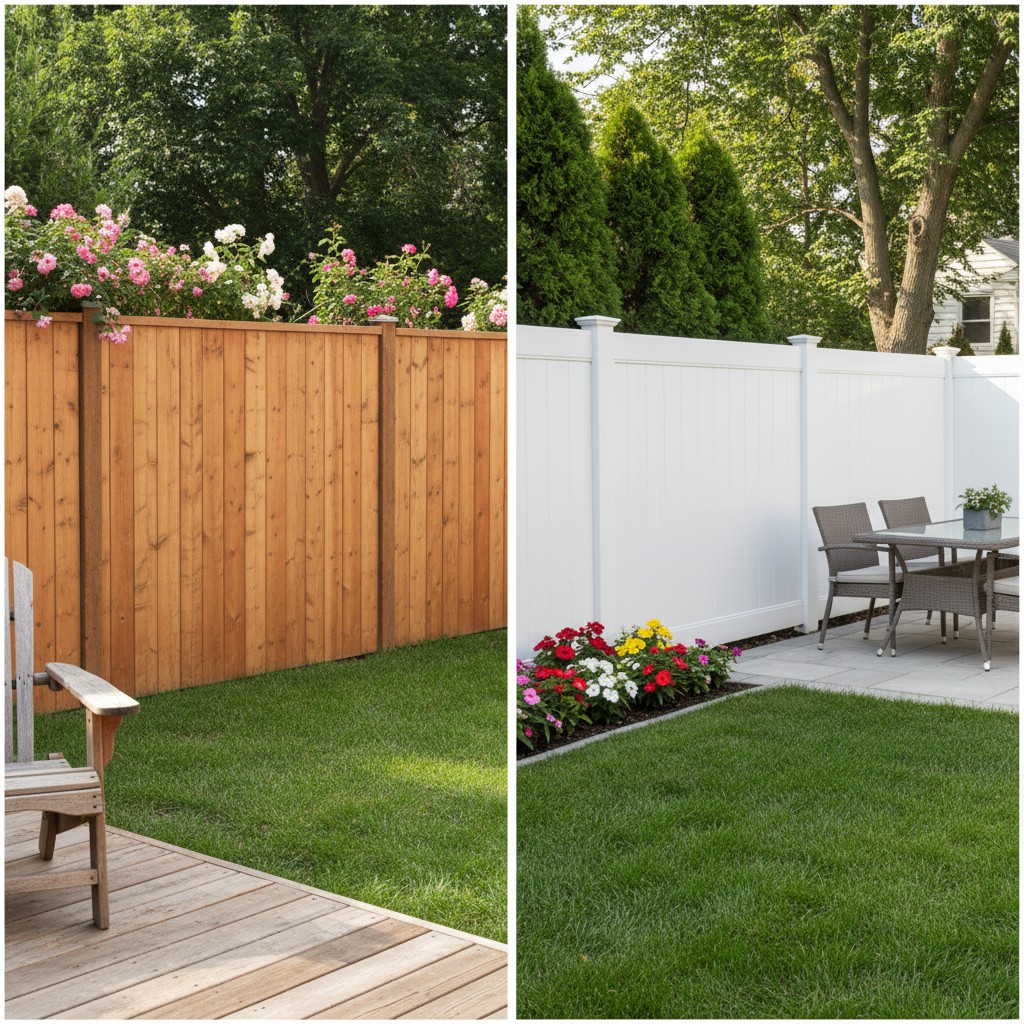
Side-by-Side Comparison Table
Here is the quick summary. Each row is explored in detail in the sections below.
| Factor | Wood | Vinyl |
|---|---|---|
| Installed cost (per LF) | $25 – $55 | $35 – $55 |
| Lifespan | 15 – 20 years (with maintenance) | 25 – 30 years |
| Annual maintenance | Stain/seal every 2-3 years | Hose off once a year |
| 20-year total cost | Higher (materials + maintenance) | Lower (no maintenance cost) |
| Color/style options | Unlimited (stains, paints) | Limited (6-10 colors typical) |
| Rot/insect resistance | Moderate (requires treatment) | Immune |
| Wind resistance | Good to excellent | Good (can crack in extreme cold) |
| DIY difficulty | Moderate | Moderate (panels snap together) |
| Resale value impact | 50 – 70% cost recovery | 50 – 70% cost recovery |
| Environmental impact | Renewable, biodegradable | PVC, not biodegradable |
Upfront Cost Comparison
On a per-linear-foot basis, pressure-treated wood and basic vinyl are surprisingly close in price in 2026 — both land in the $25 to $35 range for a standard 6-foot privacy fence professionally installed. The gap widens when you move up in quality. Premium cedar runs $35 to $55 per foot, while premium vinyl (wood-grain textures, dark colors) tops out around $40 to $45.
Where wood clearly wins on upfront cost is at the budget end. A basic dog-ear pressure-treated fence can be installed for as little as $25 per linear foot — a price point that vinyl simply cannot match. For a 200-foot fence, that translates to roughly $5,000 for budget PT wood versus $6,000 or more for entry-level vinyl. See our privacy fence cost guide for a full breakdown by material and length.
20-Year Total Cost
Upfront price only tells part of the story. Over 20 years, a wood fence incurs ongoing costs that vinyl does not.
| Cost Over 20 Years (200 LF fence) | PT Wood | Vinyl |
|---|---|---|
| Initial installation | $6,000 | $7,000 |
| DIY staining/sealing (every 2-3 yrs) | $1,000 – $2,500 | $0 |
| Board/section replacements | $500 – $1,500 | $100 – $300 |
| Post replacements (1-2 posts) | $200 – $500 | $0 – $200 |
| 20-year total | $7,700 – $10,500 | $7,100 – $7,500 |
The math is clear: vinyl costs less over 20 years when you factor in maintenance. The driving factor is staining and sealing. DIY staining runs $0.50 to $1.50 per linear foot per application, and a pressure-treated fence needs it six to eight times over two decades. If you hire a professional, expect $2.50 to $5.00 per foot per application including labor.
Of course, some homeowners enjoy the ritual of maintaining a wood fence and prefer the character that comes with natural aging. If that is you, the maintenance cost is part of the experience rather than a pure burden. But if maintenance sounds like a chore you would rather skip, vinyl's long-term economics are compelling.
Appearance & Style Options
This is where wood has a genuine, significant advantage. A wood fence can be stained or painted any color, built in any style (dog-ear, board-on-board, shadowbox, lattice-top, horizontal slat), and customized with decorative post caps, trim, or mixed materials. You can change the color every few years when you restain. No two well-built wood fences look exactly the same.
Vinyl has improved substantially in the last decade. Manufacturers now offer realistic wood-grain textures in colors beyond basic white and tan — dark walnut, gray, driftwood, and cedar-tone are all available. But the options are still limited compared to wood. You get the color you buy, and you cannot change it later. The surface has a slight plastic sheen that, while less obvious on textured products, never fully replicates the look of real wood grain.
If you are leaning toward wood and want to understand the differences between the two most popular species, our cedar vs. pressure-treated fence comparison covers appearance, cost, and longevity in detail.
Durability & Weather
Vinyl is inherently immune to the three things that destroy wood fences: rot, insects, and moisture absorption. A vinyl fence will not warp, split, or develop mold. It does not attract termites or carpenter ants. In wet climates where wood fences routinely fail within 10 to 12 years, vinyl can last 25 or more with zero intervention.
Vinyl's weakness is extreme temperatures. In very cold climates (northern states, Canada), vinyl can become brittle and crack on impact — a hard hit from a falling branch or a wayward lawnmower can split a panel. In intense heat, vinyl panels can warp slightly, though quality products with UV stabilizers resist this well. Dark-colored vinyl absorbs more heat and is more prone to warping than lighter colors.
Wood, when maintained, handles temperature extremes better. It flexes rather than cracks in cold weather. Its weaknesses are biological: untreated wood is vulnerable to moisture infiltration, fungal decay, and wood-boring insects. Pressure treatment addresses all three, and regular staining adds a moisture barrier. Cedar's natural oils provide some protection even without staining, though sealing still extends its life.
Wind resistance: Both materials perform similarly in moderate wind. In sustained high winds (hurricane zones, Great Plains), wood is generally more repairable — you can replace individual boards. Vinyl panel damage typically requires replacing the entire 6-foot section, which is more expensive per repair but happens less frequently due to vinyl's flexibility.
Environmental Considerations
If environmental impact matters to your decision, the two materials have very different profiles.
Wood is a renewable resource. Trees are replanted after harvest (particularly Southern yellow pine used for pressure treatment). At end of life, untreated wood is biodegradable. However, pressure-treated wood contains copper-based preservatives and should not be burned — it requires disposal at a landfill or specialized facility. The chemical treatment process itself has environmental costs, though modern ACQ (alkaline copper quaternary) treatment is significantly less toxic than the CCA (chromated copper arsenate) treatments phased out in 2003.
Vinyl is made from PVC (polyvinyl chloride), a petroleum-derived plastic. PVC manufacturing releases chlorine compounds and uses significant energy. At end of life, vinyl is not biodegradable and is rarely recycled in practice — most vinyl fencing ends up in landfills. On the positive side, vinyl's 25-to-30-year lifespan means fewer replacements over time, and its zero-maintenance nature eliminates the ongoing environmental cost of stains, sealers, and their associated VOC emissions.
Neither material is clearly "greener" — it depends on whether you weigh manufacturing impact or end-of-life biodegradability more heavily.
Which Should You Choose?
There is no universally correct answer, but your priorities will point you in the right direction.
Choose wood if:
- You want maximum customization (colors, styles, mixed designs)
- Budget is tight and you need the lowest upfront cost
- You enjoy occasional outdoor maintenance projects
- You live in a very cold climate where vinyl could crack
- Environmental sustainability is a high priority
Choose vinyl if:
- You want zero maintenance for 25+ years
- You are optimizing for total cost over the fence's lifetime
- You live in a humid, wet, or termite-prone area
- A clean, uniform appearance appeals to you
- You plan to sell the house within 5-10 years (buyers appreciate "no maintenance")
For more on vinyl specifically, see our vinyl fence pros and cons guide. And if you have already decided on your material, use the fence calculator to get an exact cost estimate for your project.
Related Topics
- Fence Material & Cost Calculator — Instant material and cost estimates for wood and vinyl fences.
- Privacy Fence Cost: Complete 2026 Pricing Guide — Detailed cost breakdown by material, gate type, and hidden expenses.
- Vinyl Fence Pros and Cons — Everything you need to know about vinyl fencing before you buy.
- Cedar vs Pressure-Treated Fence — If you chose wood, this helps you pick the right species.